

Ambiguity Everywhere, Awareness Almost Nowhere
Perception and language are riddled with multiple meanings and yet consciousness rarely notices.

Our own intentions and reasons for making decisions are often inaccessible to introspection, or at least ambiguous. Our memory of the past is often as poor as our ability to anticipate the future, and it is prone to be filtered through our present perspective.
Historians must routinely cope with the universal tendency of people to reshape the past in light of the present, and lawyers actively employ techniques designed to make witnesses change their memory of a crime or accident. Even perceptual domains that seem stable and reliable are actually ambiguous when we isolate small pieces of information. Every corner in a normal rectangular room can be interpreted in two ways, as an outside or an inside corner. To see this, you can simply roll a piece of paper into a tube, and look through it to any right-angled corner of the room. Every room contains both two- and three-dimensional ambiguities in its corners, much like the Necker cube and book-end illusions.
Similarly, the experienced brightness of surfaces depends upon the brightness of surrounding surfaces. Depth perception is controlled by our contextual framing assumptions about the direction of the incoming light, about the shape and size of objects, and the like. These ambiguities emerge when we isolate stimuli — but it is important to note that in normal visual perception, stimulus input is often isolated. In any single eye-fixation we only take in a very small, isolated patch of information. Normal detailed (foveal) vision spans only 2 degrees of arc; yet when people are asked about the size of their own detailed visual field, they often believe it must be about 180 degrees. Even the visual world, which seems so stable and reliable, is full of local ambiguities.
Language provides a great many examples of ambiguity. Indeed, every level of linguistic analysis has its own kind of ambiguity. Thus,
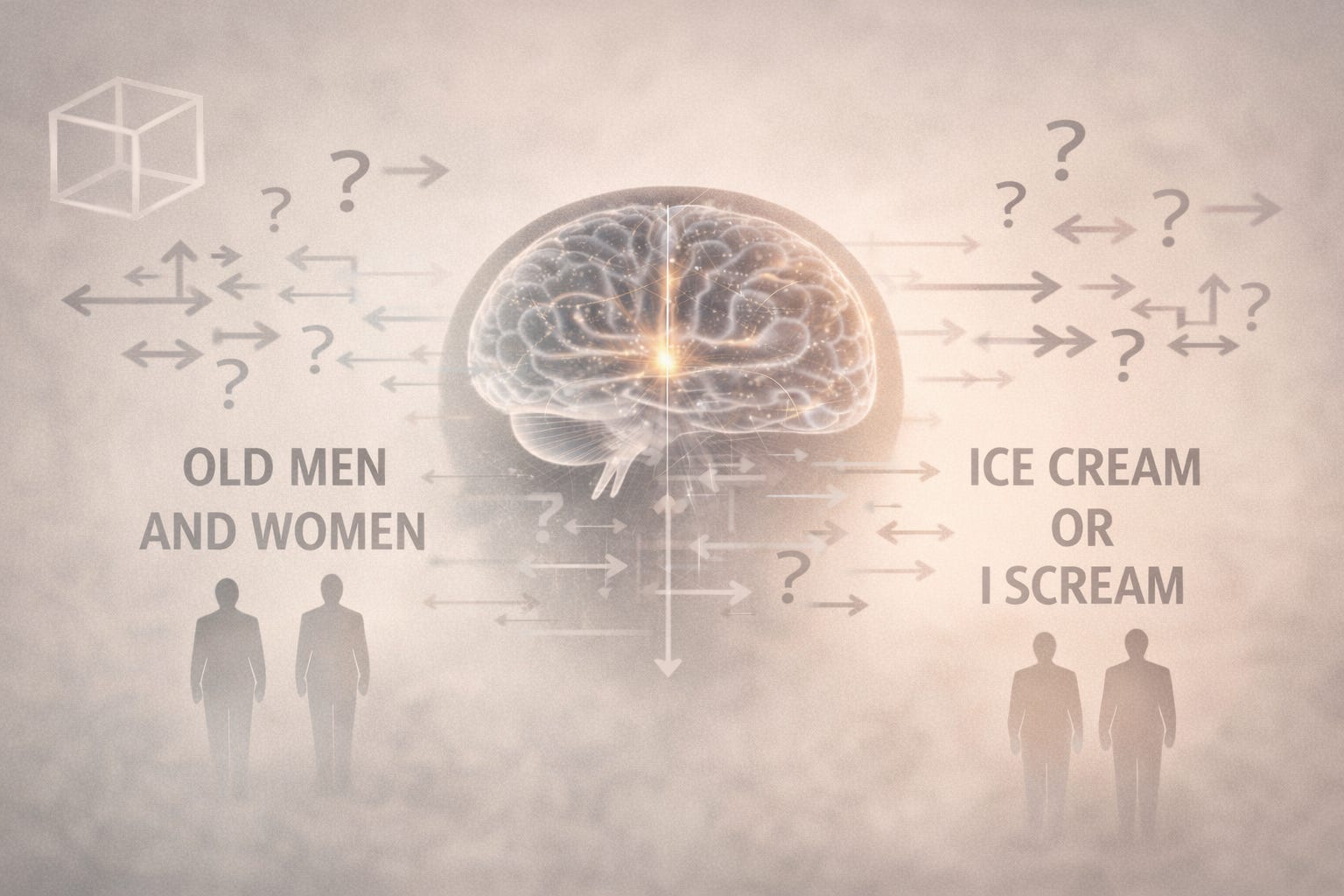
1. Ambiguities of sound. The English /l/ is perceived as either /r/ or /l/ by Japanese speakers, while the unaspirated /k/ (as in “cool”) is freely exchanged by English speakers with the aspirated /kh/ (as in “keel”). In Arabic this difference marks very different words. Most English speakers simply do not hear the tones that are critical in languages like Chinese. Further, there are many identical strings of sounds in every language that are divided up differently, as in “ice cream” and “I scream” in English. We typically become conscious of these ambiguous sound sequences only in learning a new language.
2. Morphemic ambiguity. The final /s/ in English has four different morphemic interpretations. It can be plural (“the books”), possessive (“the book’s cover”), third person singular verb (“he books the tickets”), or plural possessive (“the books’ covers”).
3 Lexical ambiguity. A glance at the dictionary should convince anyone that each word has more than one meaning. More common words tend to have more meanings.
4. Syntactic ambiguity. There are numerous syntactic ambiguities. The best-known ones are the surface and deep-structure ambiguities of Chomskyan theory. Thus, “old men and women” is a surface ambiguity that involves grouping: One can have “old (men and women),” or “(old men) and women.” Sentences like “Flying planes can be dangerous” and “They are eating apples” have ambiguities that cannot be represented in a single tree diagram; they involve ambiguity in underlying subjects and objects.
5. Discourse ambiguity. Consider the following example:
a The glass fell off the table.
b It broke.
b’ It was always a little unstable.
The referent of “it” changes between (b) and (b’). It can only be determined by an appeal to framing context, and to our knowledge about glasses and tables. Such ambiguities are extremely common.
6. Referential ambiguity. This occurs when we refer to “that chair” in an auditorium full of chairs, or to “that book” in a library.
7. Semantic ambiguity. All too often, concepts do not relate clearly to other concepts. What really is consciousness? What is an atom, or a physical force, or a biological species? All unresolved scientific questions involve deep semantic ambiguity.
8. Topical uncertainty and ambiguity. Consider the following paragraph (from Bransford, 1979, p. 134):
The procedure is actually quite simple. First you arrange items into different groups. Of course one pile may be sufficient depending upon how much there is to do. If you have to go somewhere else due to lack of facilities that is the next step; otherwise, you are pretty well set. It is important not to overdo things. That is, it is better to do too few things at once than too many. In the short run this may not seem important but complications can easily arise. A mistake can be made as well. At first, the whole procedure will seem complicated. Soon, however, it will become just another facet of life. It is difficult to foresee any end to the necessity for this task in the immediate future, but then, one never can tell. After the procedure is completed one arranges the materials into different groups again. Then they can be put into their appropriate places. Eventually they will be used once more and the whole cycle will have to be repeated. However, that is part of life.
Confused? Here is the framing context: The paragraph is about washing clothes. If you read it again, it will be much more comprehensible, details will clarify in experience, and memory for the material will improve greatly.
What is the point of this litany of ambiguities? It is that ambiguity is pervasive; but the conscious experience of ambiguity is quite rare. We generally gain information about a world that is locally ambiguous, yet we usually experience a stable, coherent world. This suggests that before input becomes conscious, it interacts with numerous unconscious framing factors to produce a single, coherent, conscious experience. Consciousness and frames are twin issues, inseparable in the nature of things.
Context is everything.
Yes, indeed, the brain's labors are riddled with ambiguity, beset with inverse and ill-posed problems at every turn, while consciousness rarely gives evidence of the problems that must be solved outside its boundaries for it to present us with the clear view of our surroundings and linguistic communications that is ours on account of the disambiguation that constantly occurs beyond the confines of consciousness. It is only when the brain fails to resolve ambiguity that we become aware of it, and so wedded is consciousness to UNambiguity, that in those cases it presents us with a percept that FLIPS between the alternatives of the ambiguity, as in the flipping Necker cube, each flipping view of which is perfectly unambiguous in its own right. The stimulus situation, meanwhile, remains perfectly constant, without any flipping. Consciousness, in other words, is so averse to ambiguity that it prefers to present us with a flipping fiction rather than a veridical ambiguity. If nature abhors a vacuum, then consciousness abhors ambiguity.
And that tells us something fundamental about the nature of consciousness. It occurs AFTER the brain's disambiguating labors (a specialty of the cortex) are done, as the final, summary, output of its busy "behind the scenes" traffic. It even encourages us to search outside of the cortex for the locus of the phenomenal content of consciousness. If this sounds a bit extreme to you, I can do no better than to refer you to a book chapter in which I deal with these matters at length, here:
Merker, B. (2012). From probabilities to percepts: A subcortical "global best estimate buffer" as locus of phenomenal experience. In S. Edelman, T. Fekete & N. Zack (Eds.), Being in Time. Dynamical models of phenomenal experience, pp. 37-79. Amsterdam: John Benjamins.
Should you have trouble accessing that book, I'll be glad to send you the pdf of my chapter if you write me at bjornmerker@gmail.com