

Cooperating and Competing Frames
Predictability, consistency, and the dynamics of conscious experience

When Frames Cooperate — and When They Compete
This post continues a short series on frames and consciousness. In earlier posts—Frames of Consciousness and When Frames Become Visible—I introduced the concept of frames and discussed how they sometimes become visible in experience.
In those earlier posts I suggested that conscious experience is structured by underlying frames.
By frames I mean relatively stable systems of expectations that shape perception, interpretation, and action. Frames normally operate outside awareness, but they constrain what can enter consciousness and how it is interpreted.
Most of the time frames remain implicit. But under certain conditions they can become visible—for example when expectations fail, when familiar patterns are violated, or when competing interpretations arise.
This raises a further question: what happens when multiple frames interact within conscious experience?
Several familiar properties of consciousness follow from this idea. Predictable inputs tend to disappear from awareness. Frames tend to maintain internal consistency. And different frames may either cooperate or compete within the global workspace.
Let us begin with the role of predictability.
Predictability and the fading of consciousness

One robust fact about consciousness is that completely predictable events tend to fade from awareness.
We habituate to repeated sounds. Predictable thoughts are easily taken for granted. Skilled actions such as typing or riding a bicycle eventually become routine and largely unconscious.
This observation suggests something important about frames.
Frames constrain many of the possible variations in a conscious content—but not all of them. Some degrees of freedom must remain open within the framed situation.
If an input were entirely predictable, the nervous system would simply habituate to it and it would drop from consciousness.
This suggests a simple way to think about conscious processing. Conscious experience may be viewed as a reduction of uncertainty within a stable frame. As incoming information becomes more predictable, less conscious processing is required. Eventually the event becomes fully predictable and therefore unconscious.
Internal consistency in frames
Frames are organized knowledge structures. Because of this they tend to maintain internal consistency.
When incoming information conflicts with an established frame, the system typically resists the change. The greater the inconsistency, the stronger the resistance tends to be.
Frames also show a tendency to complete partial input. If one component changes, other components may adjust in order to maintain overall coherence.
Consider the following example.

The Ames room illusion provides a well-known illustration. In the Ames room the geometry of the room is distorted in such a way that a person walking across the room appears to change height dramatically.
Observers must therefore revise their framing assumptions either about human height or about the geometry of the room.
At first we may abandon the assumption that human height remains constant. But if a ping-pong ball is tossed into the room, that interpretation quickly fails. Suddenly the perceptual system adopts another solution: the room itself is perceived as distorted, and human height becomes constant again.
In effect, the perceptual system trades off between two assumptions—height and rectangularity—until internal consistency is restored.
Adaptation to altered frames
The literature on perceptual adaptation illustrates another property of framing processes.
Researchers have long used distorting goggles, mirrors, and colored lenses to alter the visual world (Gregory, 1966). Under such conditions the world may appear upside down, in mirror image, or with different transformations applied to each eye.
The auditory domain can also be transformed—for example by switching the inputs to the two ears.
What is striking is how readily the nervous system adapts. In some cases adaptation occurs within minutes; in others it may take several days.
These experiments demonstrate the remarkable capacity of the human brain to reorganize its interpretation of the world when sensorimotor frames are altered.
When frames conflict
Not all frames are compatible with one another.
A scientist cannot simultaneously assume that time is constant and also that it changes. Likewise, a viewer of the Ames room cannot simultaneously assume that the visible surfaces are both rectangular and trapezoidal.
When two active frames conflict, they may produce competing conscious interpretations.
Interestingly, such conflicts can sometimes help resolve inconsistencies between frames.
Consider how jokes work.
A typical joke establishes one frame and then suddenly replaces it with another.
Take the familiar example:
Why did the chicken cross the street?
To get to the other side.
The question establishes a frame in which we expect a clever or surprising answer. The response simply states the obvious.
The humor arises because the original frame is briefly violated. For a moment the violated expectation becomes conscious—we may even feel slightly foolish for not having anticipated the obvious answer.
Laughter may be one way the mind adapts to this momentary conflict between frames.
Cooperating and competing frames
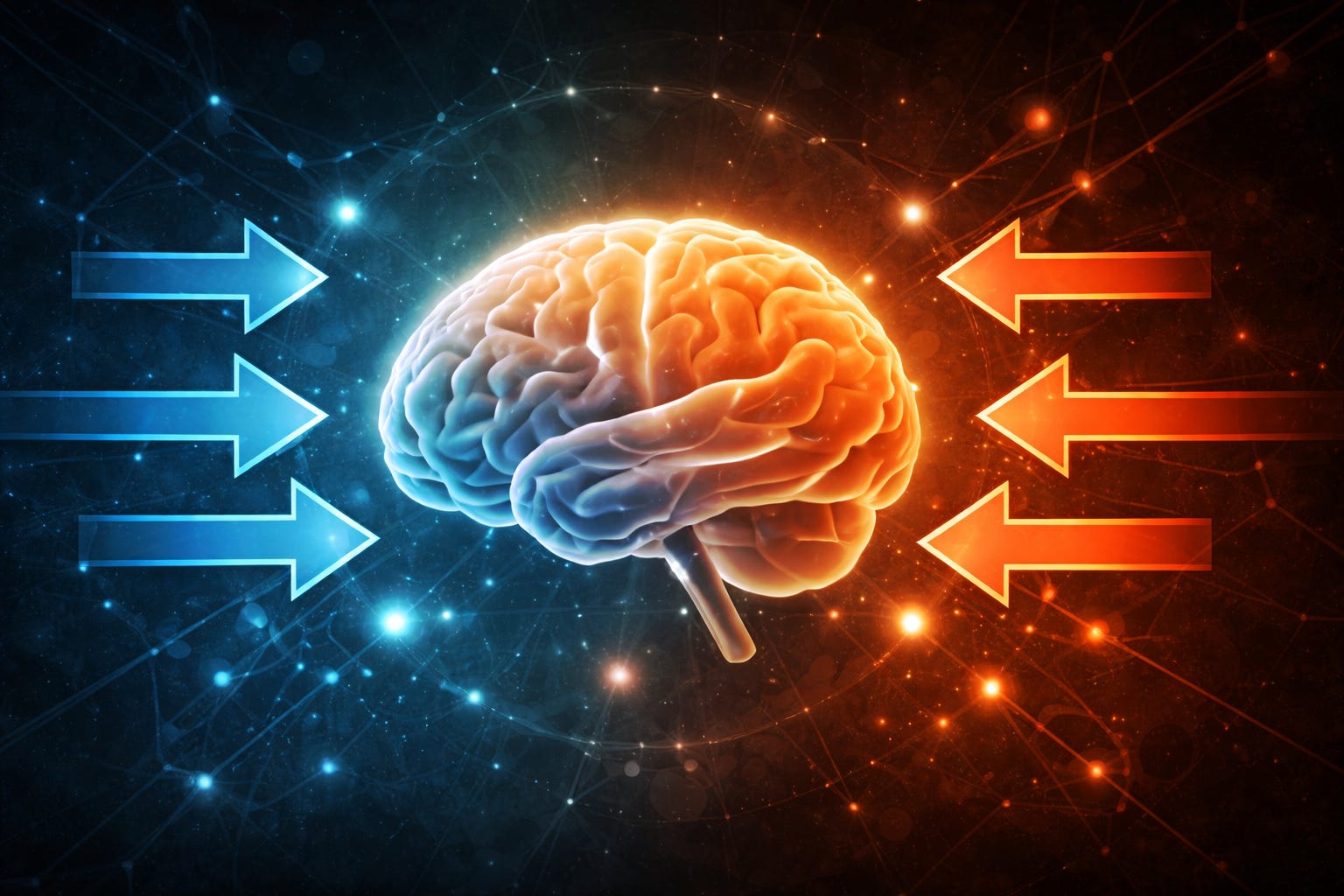
Although we can only experience one conscious content at a time, many framed constraints may operate simultaneously.
Speech perception provides a useful illustration. Acoustic cues, linguistic expectations, contextual information, and current goals all contribute to what we consciously hear.
These influences can be understood as different frames shaping interpretation.
Compatible frames tend to cooperate, reinforcing one another. Incompatible frames compete for influence.
Within the Global Workspace framework, cooperating frames form a hierarchy that dominates the workspace. Competing frames may remain active, but they do not control the current contents of consciousness.
Over time these interacting frames produce the ongoing flow of conscious events—something very much like the stream of consciousness described by William James (1890).
Bringing the elements together
We can now bring these observations together.
Frames help explain several familiar properties of conscious experience:
predictable events tend to fade from awareness
perception tends toward internal consistency
conflicting frames may produce competing interpretations
compatible frames cooperate to guide the contents of the global workspace
When frames cooperate, conscious interpretation becomes stable and coherent. When frames compete, the result may be ambiguity, surprise, humor, or the sudden revision of our assumptions about the world.
Much of conscious life may therefore be understood as the continuous interaction of cooperating and competing frames within the global workspace.
Understanding those interactions may bring us closer to explaining how the familiar stream of consciousness emerges from the underlying organization of the mind.