

Do You Remember Your Junior Year? Meet Rayna Kumar.
At 15, she had a simple goal: learn directly from people at the forefront. So she launched the Cognitive Corner podcast.


Do you remember your junior year in high school? I’ll bet you do. What were some of your goals and dreams when you were 15, 16, or 17 and how aligned are they with your life today?
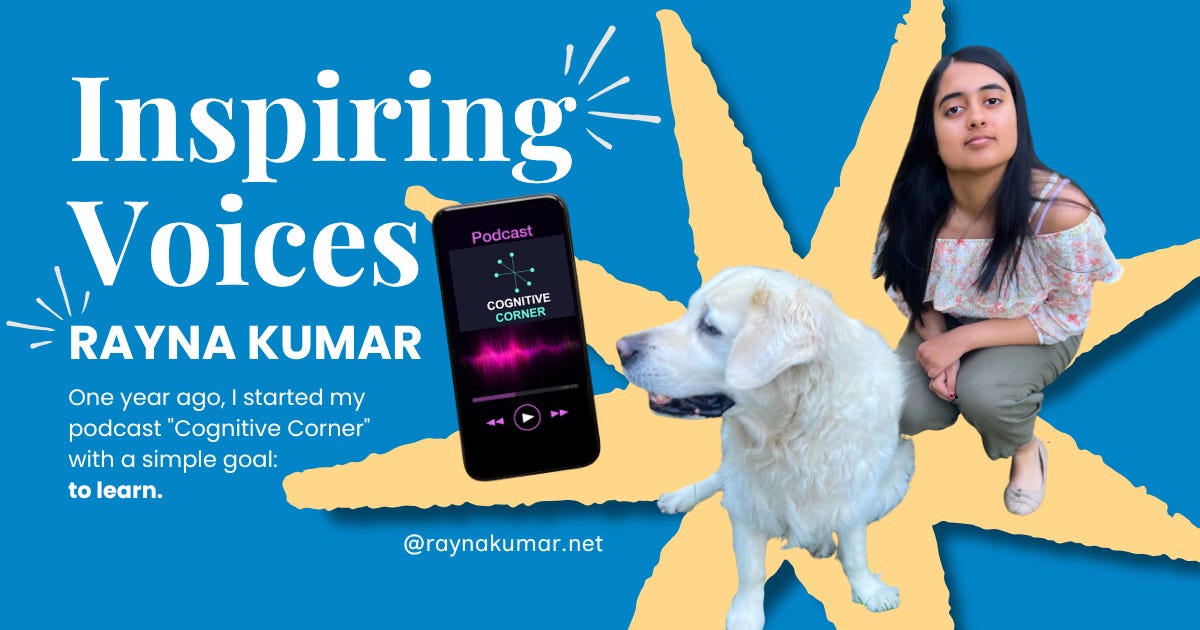
Rayna Kumar is a high school junior, creator and host of Cognitive Corner, and one of our community’s most inspiring voices. Bernard and I share many of the same interests and passions with Rayna, and we thought you would enjoy getting to know her. Welcome to our Conscious Spotlight series, where each month we share the extraordinary work of our consciousness community with you!

What inspired you to produce the Cognitive Corner Podcast, Rayna? When did this vision begin for you?
Rayna: At around the age of 14, I began to become interested in neuroscience after self-studying for the AP Psychology exam. I had always known how to code (since about the age of 8), and so around the same time, I started to familiarize myself with machine learning, which was starting to become very popular. As I learned more about cognitive science, I became increasingly interested in finding a way to spread my knowledge with others.
I started developing Cognitive Corner at 15, as a way of delivering information related to the cognitive science space to people my age in a way that felt understandable and straightforward. I wanted to ask questions I was genuinely curious about relating to all of the fields I was interested in, including neuroscience, AI, psychology, how the mind works, and learn directly from people at the forefront of these fields.
Any favorite highlights from your interviews?
Rayna: I enjoy talking to researchers about work that feels really advanced and is difficult to conceptualize because it feels so far into the future. One really good example is the part of the conversation I had with Professor Moran Cerf about his work with dreams. He described how you can not only observe or predict the story of someone’s dreams but also manipulate dreams and control them to see images that you find comforting. This was fascinating to me, as I had never thought this was possible with current technology.
Has anything surprised you while producing the podcast?
Rayna: While researching on my own, I’ve found that concepts in machine learning and neuroscience are often very complicated and difficult to understand without a lot of background knowledge. However, when I interview experts in the field, all of them are extremely good at explaining their very complex, layered work to an audience in a way that feels digestible and understandable. This has always been very impressive to me, and has made the experience of recording Cognitive Corner much more enjoyable.
Which 3 books are you reading these days? And is there a book that you return to often?
Rayna: I recently finished Slaughterhouse-Five by Kurt Vonnegut and The Catcher in the Rye by J.D. Salinger. I am currently reading The Master and Margarita by Mikhail Bulgakov.
The book I return to most often I think is Little Women by Louisa May Alcott, which has been one of my favorite books since I first read it when I was eleven years old. I think it has a lot of valuable life lessons that anyone of any age can apply to their lives. The characters in the book are complex and flawed, which only makes their journeys more rewarding and makes them easier to see yourself in.
You mentioned your sweet dog Bruno on your website, what do y’all love to do together?
Rayna: Bruno tends to get very tired easily, so especially when he was younger, he and I would just sit outside in our backyard and enjoy nature. It was a really good chance for me to take a moment to relax and simply observe my surroundings.
What is your wildest dream?
Rayna: Creative writing is one of my biggest hobbies, and I would really like to be able to publish one of my books one day.
We are so impressed with your dedication, curiosity, and intelligence. How are you enjoying your 2nd season of Cognitive Corner?
Rayna: What began as a curiosity-driven project has turned into one of the most rewarding experiences of my journey. I’ve had the privilege of speaking with incredible scientists, clinicians, and innovators, each conversation expanding my perspective in ways I never could have anticipated.


Ep 8. Neuroscience Behind Emotion, Dreams & Engagement with Moran Cerf + Transcript
In Mini-Course #10, neuroscientist Moran Cerf discusses his research recording single-neuron activity in awake human patients with Rayna Kumar in her podcast, Cognitive Corner. Dr. Cerf’s method is unusually direct: by placing electrodes deep inside a clinical patient’s brain he is able to listen to individual neurons firing in real time, while the patient is fully conscious and able to report their thoughts and experiences. This rare combination of single-cell precision and voluntary human report gives his work a distinctive place in consciousness science: eavesdropping on the human mind, one neuron at a time.
The Neuroscience Behind Emotion, Dreams, and Engagement with Prof. Moran Cerf, neuroscientist, Academic Director of Executive Education at Columbia University, and Alfred P. Sloan Prof. at American Film Institute is worth your time, in case you missed it. Rayna has provided us with the transcript below.
(00:11) Rayna Kumar
Hi everyone and welcome to another episode of Cognitive Corner. Today my guest is Dr. Moran Cerf, a neuroscientist, academic director in executive education at Columbia University and the Alfred P. Sloan Professor at the American Film Institute. With a background in neuroscience, philosophy, and physics, his work explores how the brain drives emotion, decision-making, and what makes content engaging. He is known for recording single neuron activity during brain surgery to study consciousness and behavior. A former cybersecurity hacker turned academic, Dr. Cerf also advises companies and Hollywood productions for getting neuroscience into business, storytelling, and real-world decision-making. And he’s also a four-time US National Storytelling Champion.
Dr. Cerf, thank you so much for joining me today. It’s wonderful to have you here.
(00:57) Moran Cerf
Of course, it’s a pleasure.
(01:58) Rayna Kumar
So, my first question was just, you have one of the most unconventional career paths I think I’ve encountered. You’ve done cybersecurity, neuroscience, and you’re also a Hollywood consultant. So I was wondering if you could just explain how you went from hacking to studying individual neurons in the brain.
(01:16) Moran Cerf
Well, like most things in life, I think you can only explain that backwards when you tell a story. But if I were to make up a story of why things happened the way they were, I would say that cybersecurity was what I was good at. So I first went to something that I was good at. And I became fascinated by the idea of breaking into vaults and black boxes. And once the company did well, I figured that neuroscience is a bit like that. Like the brain is somewhat of a black box. You don’t know what’s going on inside. You only control the inputs and check the outputs and try to understand how it works. And in that sense, I felt that my abilities and my skills in cybersecurity might be useful and relevant for this one. And the Hollywood was, of course, random as well. I went to graduate school in Los Angeles. And one day, I was walking in the main street in Los Angeles where my campus was. And there was a sign that said that some TV series is looking for a science consultant who can essentially read the script and put science in different locations where they need it. And they paid $20, which, when you’re a grad student, felt like a treasure. So I signed up and started to help TV series put science. And I was good at . So they kept coming again and again. And at some point, I started to also weigh in on this script itself. And I started to copy the ideas, and they liked them. So at some point, I became kind of a part of the experience, not just a visitor.
(02:52) Rayna Kumar
Wow. That’s very, very interesting. I was also wondering, since you have so much experience in so many different fields, how would you say your interdisciplinary experiences from all these different fields have strengthened the work you’re doing now?
(03:07) Moran Cerf
So I think I’ll give you two answers. One more kind of high-brow and one more concrete. The concrete one is that if you have more than one thing, then when something fails, instead of just kind of sinking into misery and say, “Oh, nothing works,” you have something else to try, and then it works. So if science doesn’t work sometimes, which is a frequent thing, it tries something that doesn’t work, and instead of just getting frustrated, you can say, “Oh, I’m going to read a script now.” And it’s an alternative reality that you can play in. And if you have enough of those realities, then you kind of never have this despair because you always have something to go to. That’s kind of a more concrete, pragmatic thing for me.
And the more, I think, sophisticated answer would be that I think there’s some overlaps and also some usefulness to having kind of your feet in multiple domains. You know, when I talk to movie creators in Hollywood, they often come up with really good ideas when they think about science fiction. But when I consider those ideas in reality, I sometimes see that there’s a merit to them and something you can do in the real world with those ideas, not just in science fiction world. And we try them in the lab, and sometimes they work. And so that’s like a classical way where you can take one domain and apply to another. Talking to companies, basically kind of leveraging my access to the business world because of my former company and my access to cyber people, means that I get to know about new techniques. And those techniques are sometimes relevant for accessing the brain or for statistics or for ways to measure performance. And all of those things are coming from a different field. And if you didn’t have kind of access to both those worlds, you wouldn’t know that this guy is working on something that’s going to be relevant to that one. So I think that having multidisciplinary experiences is usually something that you can draw from and get yourself into more than one domain.
(05:07) Rayna Kumar
Yeah, yeah, that makes a lot of sense. And I was wondering, a lot of young people, like high schoolers and university students, they usually, these days, pick one path and they sort of focus very intensely in that. Do you think it might help people in general just to sort of, at that stage, keep a more open mind and try to gain more experiences in different areas?
(05:28) Moran Cerf
So I’ll say something that’s counterintuitive, I guess, in this way. In a way, it’s always a good idea to have kind of interdisciplinary knowledge and kind of to understand the world differently and to seek your passion and so on. But I would say that too much of that ends up with kind of like too much muddying of your skills. And you’re not really the perfect person for anyone. And I think that there’s something to be said to the, at least on one domain, focus and dive deeper. Most people, I think, can be really good in more than one thing. I think the days of you kind of just one thing and that’s it, what you that’s what you do for your life, are over. I think that there are many people I know who are the best at writing and the best at coding and the best at kind of being funny and the best at football. So they’re really the best, and that’s okay.
Like it’s common to have now people that are really, really good in many, many things. And it’s even, I would say, something that people that strive to be good at things tend to not just kind of be okay in one and mediocre in the other, they actually try to be good at everything. And that’s, since I think that there’s something that I totally advocate for in terms of like being the best at and more than one thing. But I think that there’s something to picking a lane and just, for the sake of sticking there, doing it. So you’ll see how it is when you get good at something necessarily by putting the hours. And another anecdote, but nice thing I learned, is that when people actually become good at something, even if it’s not something that they really cared about in the beginning, they end up caring about a lot when they become good at it. And many times, they also find interesting things in it. So I have students who come to me, and I tell them, you’re going to study, I don’t know, something in, say, marketing. And I say, marketing, it’s the most boring. I don’t care about that. And I say, just do it so you can get a PhD. So you can do something safe. Like you’re going to do whatever you care about and passionate about on or so. But at least one thing you should do that will get you a PhD. And they pick this kind of thing that they don’t necessarily love in the beginning. And by the end of the five-year PhD, many times, this thing that I forced them to do just so they will have a safety net ends up being the thing that they actually care about the most and become amazing at that. So suddenly, there are many opportunities emerging and so on. There’s something to just sticking and staying that I advocate for.
(07:53) Rayna Kumar
Yeah, that makes a lot of sense. So diving deeper into your work in neuroscience, your research involves recording from individual nerve cells in patients during brain surgery. So I was wondering if you could just briefly explain what that looks like and what that information is used for.
(08:09) Moran Cerf
Sure. So I’ll say to those who hear about it for the first time that it’s a very kind of, it’s a real type of research that even among neuroscientists, they’re only a handful of neuroscientists. Most neuroscientists study the brain either by looking inside the skull of animals, like they open the brains of mice or rats or pigs, or they look at the outside of the brain of humans because you don’t want to probe into their brain. So they use machines that are imaging the brain from the outside to understand what’s going on, on the inside. Those are the classical neuroscientists, and I sit in the unique place between those two, where we actually open the brains of humans and stick electrodes and put implants inside their head. So it’s rare because not that many people would let you open their brain and put something inside. And the way we do that is we work with patients who undergo brain surgery. And for the purpose of the surgery, for the clinical purpose, they are okay with a neurosurgeon actually opening their skull and putting a chip inside their head, touching the actual brain from within and using these very fine electrodes that you put inside their head to understand what’s the problem that they have and how to fix that.
So think of it, for example, as epilepsy. You have a person who has epilepsy, they have seizures, they tried every type of medication in the world and nothing helped them, and they still have seizures, and it becomes a life-threatening thing, and they want to end this. They want to kind of get cured. So one of the options is for them to go to a surgeon that opens their brain, puts electrodes deep inside their brain, next to the area in the brain where we suspect the seizure onsets are. Now you have electrodes in the brain, eavesdropping on the activity of individual neurons, tiny neurons. And you now have the patient sit there with open brain, awake, reading a book, looking at the TV, and waiting. And they’re waiting to have a seizure in the hospital with electrodes in their brain because now, if you have a seizure, the surgeon can actually trace the onset of the seizure’s location and really triangulate the exact neuron or set of neurons that started the seizure, resect those neurons, so basically take out the part of the brain that is damaged, take the electrodes out, close everything, and send the patients away fixed. No longer have epilepsy, they’re not getting medicine for the rest of their lives, they’re actually getting fixed.
So that’s the clinical purpose of these electrodes in the brain, and what I do is I, if you want, piggyback on this procedure where I come to the patients after they have the electrodes in their brain and I say, here’s the situation, you are sitting here in the hospital for the next two weeks waiting to have seizures so they can know where the onset of the seizures are. Would you mind also giving me, a scientist, the opportunity to talk to you and ask you questions while I also look inside your head and listen to your brain cells, so I can ask you if you love mom and dad more and you say, I don’t know, dad, but I can see which neuron kind of came to life, or spiked, if you can. At that moment, and essentially, is the thought, I love dad more than mom. Or if I ask you, do you have more chocolate or vanilla, and you say vanilla, and I see another cell lighting up, I can predict that this cell has to do with you thinking about vanilla. And I can trace it even further, understand how emotions work in the brain, how memories work in the brain, essentially understand the brain from the inside while I have you as a human tell me what you’re thinking and your brain tell me what it codes.
(11:37) Rayna Kumar
Wow, that’s amazing. I’m curious, since you mentioned that this sort of approach is a little more unique. When you first, got into this type of work, was this approach, like, very new at the time, and sort of, how has it changed?
(11:56) Moran Cerf
So, in a way, it’s still very, very new. Today, you still have only dozens of people in the world who are doing that, but to extend it’s very, very old. The first guy to come up with the idea of putting neural implants in people’s brains for epilepsy is Wilder Penfield. He did it almost 100 years ago. So he was the first neurosurgeon somewhere between the US and Canada. He’s American, but he lived in Canada for much of his life. He was the first to do it 100 years ago. And he didn’t think that it’s going to be used for anything but surgery in the beginning, but he himself evolved with the procedure and realized that you can also ask people questions and use the fact that he had an extra brain to understand how thinking works. And he did it, and then he did it for many, many years and was considered the father of this field. And then another guy after him was kind of like the son, if you want, and he did it second, and then another person did it third. And over the course of the last 100 years, there’s probably been six or seven kind of prominent neurosurgeons that each carried this field for decades and was the one who were doing the surgeries. And at some point, maybe 15 years ago, it became big enough that now there are more than just one at a time, but maybe five or six neurosurgeons in parallel that are doing that. The US has multiple labs, but still a small number of labs, and each of those labs gets a patient every now and then, a surgeon to open their brain, and a small number of scientists who show up and say, now that we have the patient with the brain open, let’s also do science with them.
(13:28) Rayna Kumar
Yeah. Wow, that’s very interesting. The other question I sort of had was, are there any risks associated with having these implants in during surgery?
(13:41) Moran Cerf
So there are numerous risks always with brain surgery. It’s not the default option for almost anyone, but I would say the risks are minimal, and they are kind of outweighed by the benefits. As in, if you have epilepsy, your life is always challenging. You might not be able to drive a car because we know if you’re going to have a seizure while driving and you’re in an accident. There are some activities you continue to engage with because, again, we don’t know when this is going to happen, and if it does, in a spontaneous moment, in a moment that you’re at risk, it will risk your life. So this is a life that’s already risky in that sense. Having a procedure that fixes that makes your life better. The risks from the research are nearly non-existent. The risks are mostly from the procedure, but I’ll say that at the same time, it’s done in the most sterile environment and so in the safest environment, so risk-free, as much as possible. I think that I would say that this is one of the least risky exposures you can have, especially if you have a disease that you want to fix.
(14:45) Rayna Kumar
Yeah, that makes sense. The next thing I wanted to sort of ask about was, you’ve also sort of researched emotions, so I was wondering, has studying, like, individual neurons, what has that taught us about emotional control and emotions?
(15:02) Moran Cerf
Sure. So I told you about the kind of the procedure where we put stuff in the brain, but what I didn’t say, and that is the next step, is what are we actually asking the patients to do and where do we put electrodes. So, as you said, we put electrodes in various locations, sometimes in the part of the brain that codes emotions. So essentially, we have electrodes right where your brain, if you want, has the activity that is correlated with being sad, being happy, being scared, which means effectively that I can talk to the patient, and if I see that a neuron is firing in the amygdala, I can predict that they’re getting scared or at least thinking about alarming things. And I can see that sometimes seconds before they actually experience the feeling, so I can tell that they’re getting scared or getting agitated or getting emotional about something before they actually experience this emotion, and it shows us, first of all, the gap between the brain starting to kind of elicit or evoke this activity and the moment you actually experience that, which is sometimes seconds.
It also shows us how this activity can be somewhat controlled, so with those patients, we can essentially feedback the signals from the parts that are activated when you’re about to feel sad to a person who’s not feeling sad yet and tell them, you know, this activity predicts that you’re going to get sad soon because of, say, the movie you’re watching. Try to do something to stop it. And then they can kind of take control over their emotions early enough that they have more reins over them.
And what we do with patients is exactly that. We teach them how to control their emotions. We teach them how emotions actually work in the brain. We show them how complex emotions work, complex emotions meaning our emotions that are less well defined. You know, sadness is pretty easy. Happiness is very easy. But jealousy, or those are more complex emotions that people have a harder time kind of defining. So we can actually help them really feel those and experience those differently, and we basically let them have access to something that normally just dawns on us.
Normally, emotions aren’t chosen. They happen. And we now have people learn to control them. To explain that maybe further, when you hear that, I don’t know, your mom is sick, you’re not saying, you know what, that should activate sadness. Let’s turn on sadness for a while, feel sadness for a few minutes. Okay, let’s turn off sadness now. Let’s kind of go into neutral. None of that happens this way. It’s kind of happening to you, even though it’s your brain making the sadness. You’re just subjected to it. You’re kind of feeling it without having control. What we give the patients is control.
(17:28) Rayna Kumar
Wow, yeah. Another aspect, or another, like, facet of this research that I wanted to ask about was dreams. You’ve also studied dreams with these methods, so what does this tell us about our brains when we dream?
(17:44) Moran Cerf
Well, so first of all, let’s kind of understand dreams are a huge thing, and there are many interpretations to what they are, what they mean, and so on. We leverage the fact that we have access to this person’s brain even when they’re sleeping, and we can essentially look at the visuals that they’re going through even when they’re not there consciously to tell us what goes on in their brain. So this is maybe the only way to really get to read someone’s dreams, which by itself is interesting.
And what we do is essentially have the patients such that when they’re awake, they show them, say, hundreds of pictures. And when a picture is in front of their eyes and a brain cell lights up, we say, aha, there’s a chance that this brain cell is somehow coding what’s in the picture. Maybe it’s a cell that fires when you see a picture of, say, the Eiffel Tower in Paris. And we say, okay, this is either a cell that fires for Eiffel Towers or for towers or maybe for things in Paris. But we can quickly kind of fine-tune by showing you a few more other pictures of other towers or a few pictures of other things in Paris and figure out exactly what this cell cares about.
At the end of the day, after a few hours of kind of this process where we show you things and find cells that are activated, we can map the brain and say, okay, we found the cell in the brain that comes to life when she thinks of the Eiffel Tower, the one that comes to life when he thinks of a Windows computer, and one which thinks about Advil, so totally kind of random different things we can find.
And then we can say, now go to sleep. And when you go to sleep, we essentially let your brain go where it goes, but we look at the same cells that we looked at when you were awake. And if we see that the Eiffel Tower cell lights up while you’re sleeping, in a specific window of time where it’s more likely that you’re actually dreaming, we can now predict that probably in your dreams you’re seeing the Eiffel Tower. And if we have enough of those cells, we can start predicting the full story, not just kind of Eiffel Tower and maybe Advil, but maybe she’s in Paris and she’s sick and her mom is there because we see the mom cell lights up, and we can start building a narrative to the dream.
And then we can even wake you up and ask you what you remember and compare what we think to what you remember. If you forgot, we can give you a hint to some of the story and let you continue it and see how similar your continuation is to the one we came up with. All of those techniques are ways for us to actually know that we’re accessing your dreams and seeing your dreams in real time.
Then one thing is to kind of display the dreams and use that as a way to give you all kinds of accesses to the narratives that your brain comes up with. Another thing is to either stop bad dreams or change bad dreams just by waking you up or at least kind of doing something that will allow you to get some control or the hallmark over the time to do right now is actually right dreams into your brain. So you’re going to sleep, and we actually control what you’re seeing and essentially control the visuals that you see by giving your dream. That’s the ultimate goal of what we’re doing right now.
(20:35) Rayna Kumar
And by that, when you say that last part, do you mean, like, lucid dreaming? Is that?
(20:41) Moran Cerf
So lucid dreaming is the more popular version of that, but I meant actually a lot more invasive. So lucid dreaming is something that anyone can do. Lucid dreaming, Rayna can now practice a little bit how to do that, and without any electrodes in the brain, without anything, she can go to sleep. And about 1 in, say, 10 people will experience that just naturally. They will, at some point during the night, kind of feel like they are waking up but not really, as in their conscious mind is going to be awake, but they’re still in a dream.
And once they are able to do that, if they don’t quickly wake up, they’re able to stay in this mid-state of between awake and sleep. And what is unique to this state is that you are understanding you’re dreaming, and you can control the dream. Instead of, like, being an actor in a movie, you become the director. So you can really decide to, say, take the dream to a different direction. You say, okay, I’m gonna now choose to open the window and fly above New York City in my dream, and it actually happens. You fly and you see the city from above.
Or I would love to have a chat with Grandma right now, and boom, your grandma shows up in your dream and she talks to you. And even though it’s your brain putting words in her mouth, it still feels like a conversation with someone that you don’t know what they’re gonna say. And all of that is lucid dreaming.
So this is one thing, and this everyone can do. What we’re doing is we’re taking the patients who have electrodes in the brain, essentially because they have electrodes inside the head, we can really do more than just small kind of adjustments. We can essentially navigate the narrative into its own world. You can say, basically, my dream is to go to Mars, and we will use all kinds of cues to get your brain to a state where Mars is much more kind of activated in your mind, and then you might really go to Mars in your dream.
(22:25) Rayna Kumar
Are there any benefits of being able to control your dreams that just may not be obvious to someone who isn’t in this type of work or who has never looked at this before?
(22:36) Moran Cerf
So there are some kind of obvious benefits, but I’ll say that right now we’re not certain at all that it’s a good idea. So, you know, there’s maybe a reason why nature chose to make dreams very impenetrable, and they get erased almost entirely when you wake up. So kind of nature worked out to hide them from us, and now the fact that we’re poking at that could be something that is not ideal. So we’re kind of asking another question right now as well, should we go there fully or just in some cases?
The advantages are many, starting from healthcare. So if you’re a person who maybe is having bad dreams, nightmares, nightmares routinely, we can just get them out of those. So that’s an easy one. Or can navigate them out of it while they’re still asleep. That’s an easy one. We can understand what people are dreaming if they cannot articulate them. So if you’re a person who’s not, say, who’s immobilized and you cannot speak, we can see what’s going on in their dreams, maybe use that as a way to access their thoughts.
We can give people a chance to correct experiences in the real world. So if you’re suffering from trauma, say you’re a soldier with PTSD that saw all your friends exploding in a tank and you couldn’t do anything to help them, we can now create a dream for you where you do get to help them. And even though it’s just a dream, it actually saturates some emotions, and when you wake up, you feel a little bit different about this thing.
We can use dreams as a way to rehearse experiences. Let’s say you’re really asking yourself if I should move to Canada after I finish school or stay in the US and do something here. We can essentially give a simulation where, for a few minutes in your dream, you get to be in Canada. And even though when you wake up everything is erased, you still have some feelings and residues of the experience that you can use to draw from that and maybe make a decision that’s more informed.
All of those are positives that are, I would say, in the domain of, like, helping people healthcare-wise. There are things that are entertainment. Imagine that you can ask for any experience you want in the world and live through it. VR is basically that in a very limited way where you always know that you’re in a VR experience. But if you really can be on Mars for a few minutes and feel like you’re on Mars without any kind of confusion, or be where the dinosaurs were and really live with dinosaurs, or go to essentially any theme park in the world for a few minutes in your sleep, that’s a fantastic experience.
Industries that looked at it also thought about it as a way to really simulate things that you cannot experience in the real world. You really want to understand how it is to be someone else, you can wake up in their body and for a second feel what it is like to be, I don’t know, a man in a different part of the world compared to a woman in this part of the world. Those are the type of things that are kind of more, you know, education, I would say.
And then there’s just pure entertainment. You want to go on a date with a guy and come back home and not just finish the date by going to sleep next to him, but essentially continue the date in your dreams. Then we can essentially give it to you, and you get to together in your dream do something that you can then share with him or her when you wake up. And suddenly you have another experience that, even though you made it up for your brain, you can share it in the real world, and it becomes a shared experience.
So all of those are examples of amazing things besides healthcare.
(25:55) Rayna Kumar
Wow, yeah, that is fascinating. It sounds almost futuristic in a way. I was wondering also about sort of the topics that come up often in dreams. Is there a reason that people frequently dream about things that are frightening or anxiety-inducing or disturbing, like things related to trauma? Is there a reason that happens and that dreams aren’t always, like, completely random?
(26:17) Moran Cerf
So there are some theories on what dreams are for, many, or I say at least seven. I know seven theories with many, many examples that suggest why this one is right and that one is not and so on. And one of them has to do with the fact that dreams are our brain’s way of essentially rehearsing things on a safe kind of standing so that when they’re in the real world, you’re prepared.
So if you’re living in a place that has bears, you don’t want to think about what you’re going to do when you encounter a bear for the first time when you encounter the bear. It’s better if you’re rehearsing that, and dreams are our way of doing that. Your brain basically says, okay, what’s a risk that’s surrounding me right now? Let’s put it in a story where I’m going to wake up and experience that and then see what I’m doing and train my body to respond to it, to do the right things, so that when it happens in the real world, I’m prepared.
And this is one of the seven theories, and if you buy into this one, it makes sense why people have bad dreams, so to speak. There are bad experiences in the world, and this is our brain’s way of preparing us for those things so that we’re kind of ready when it happens.
(27:21) Rayna Kumar
Yeah, that makes sense. Now I want to talk about another sort of aspect of your research. You also look at what makes content engaging, so I was wondering if you could just explain, like, broadly, how does neuroscience answer that question? What does it teach us about how attention works?
(27:38) Moran Cerf
Sure, so a lot of people watch a TV series or listen to a podcast, and we all know that some of them work and some don’t. Like, some people, when they speak, everyone listens. You can’t take your eyes or your ears away. You don’t think about anything else. Like, whatever they say resonates. And sometimes it’s not the case, and we ask the question, what’s special to those people or those experiences?
And essentially, because what happens in those experiences at those moments is the brain somehow is taken over by this entity, by this movie, by this person, we said, let’s bring some people that are very engaging and some that are not and have people essentially listen to them, and we’ll scan their brains and see if we can figure out what is common to all the moments where someone is captivating and to some that are not.
And what we saw is that the essence of, like, being captivating is taking over the brain in a way that removes the personal experience entirely. You essentially get exported out of your brain. It’s like if I’m very interesting right now, I take over your brain entirely, and very little of your brain remains Rayna’s. Under your spell, you just don’t have control anymore. You kind of give all of your thinking to me.
And what’s amazing about that is that if a person is very interesting, they do it to a lot of brains at the same time, even though the brains are very different. So your brain is very different than that of a, I don’t know, 60-year-old man in Nicaragua, but somehow if I’m interesting, then despite the fact that the brains are so different, I’m able to capture his brain and your brain at the same time and kind of make you operate in the same way.
And the way we know that is that we look at your brain and his brain, and we see that you’re very similar. The two of you suddenly, when I speak, look like you’re one. And the more I can make all brains look like one, the more interesting I am.
And we just played with music and stories and movies and commercials and a lot of domains, and we got the same result, that interesting things make all brains look alike, essentially think alike. This kind of idea materializes really, really well in brains when people are interesting.
(29:46) Rayna Kumar
Okay, wow, that’s very interesting. Yeah, I wanted to, since we’re talking about, you know, what’s interesting to people and since you mentioned movies, I also wanted to ask about your work consulting on movies. What’s something about, like, the brain or about psychology or neuroscience that Hollywood movies, you know, often portray incorrectly?
(30:10) Moran Cerf
Oh, I got the one for you. There’s one that totally kind of makes my, I don’t know, brain explode, which is that saying that we only use 20 percent of our brain. That’s the one that I hate the most. It’s kind of so popular, and it’s so wrong. It’s not true.
(30:32) Rayna Kumar
Yeah, definitely. If I’m not wrong, we use basically all of our brain, right?
(30:36) Moran Cerf
Yeah, I mean the thing, the way to think about it, is like it’s a piano. You never press all the keys at the same time. This would be a cacophony. You press several keys at any given moment, but at some point you’re gonna press all the keys in the piano. That’s actually how our brain works. You, at any given point, have some parts of the brain that are less active and some that are more active, but overall every part of your brain is going to be used. And jokingly, I say when someone tells me that, that maybe they are using 20 percent of their brain, but most of us use 100 percent of our brain.
(31:05) Rayna Kumar
Yeah, that makes sense. That’s a very good analogy. Going back to neural implants and brain-machine interfaces, in the near future, where do you see this field going, and what are you most excited about looking into in the future?
(31:19) Moran Cerf
So as of, I would say, the last, I don’t know, 10 years, even less, seven or eight years, a lot of kind of business people have entered this space. You know, there may be, most of us, a company, Neuralink, is a company by Elon Musk that took a lot of the type of research that we did and turned it into a product. And they’re trying to do the same thing, put neural implants in people’s brain and read their thoughts to do something.
Now those companies have tons of money, tons of people, and a lot of, like, ways to do it in different settings than what we do in science labs, which means they’re actually moving faster. They also break things more, but they move faster, and they are, I think, now spearheading where it’s going to go in the coming years.
So what they’re doing right now mostly is trying to take patients who have a brain disorder that made parts of their body not function. So the idea would be that you had an accident, let’s say, and the connection between the part of the brain that controls your legs is severed. So your brain can still send a message, move the legs, but somewhere in the spinal cord there’s a kind of break that the signal doesn’t get to the legs, and you are immobilized. You’re in a wheelchair. You’re unable to move.
And what they say is let’s put an implant right where the part of the brain that reads the signal is so we can read the desire to move the legs and give you a prosthetic leg or connect an activator to the muscles of the leg. So we basically bypass the spinal cord. You think the thought, and it activates the legs or a robotic leg.
So ultimately, you can go back to work without the need to have the transmission kind of work in the same channel that it used to work before. And this could be a person in a wheelchair because they can’t move, learning to walk again, a person who couldn’t move their hands, you know, to use their hands again, a person who was blind learning to see again, a person who was deaf learning to hear again. So that’s where I think this field is going, and there are more and more companies that are aiming at that thing.
And I’ll say secondary to that, there’s an effort by the same companies to create a world where neural implants become a recreational thing. So what they say, not sure I’m supporting that, but that’s the reality, is that right now your phone is your interface to most of the world. If you want to navigate the world with a map, you typically type on a map app where you need to go, and it goes to a cloud, it gets your directions, and then that’s how you know where to go.
If you’re trying to, say, I don’t know, learn something, you on the phone type Wikipedia, ask the question, get the answer. And what they say is if we put the neural implant in your head, you wouldn’t have to type on your phone. You will just think the thought that says, how do I get to this place or that place, or how do I kind of, or when was the, you know, French Revolution, and the thought will activate the chip in your head that would go to a cloud. We get the maps, and you will just feel like you know the answer, just feel like you know how to navigate without actually consulting the map directly. You’ll just do it indirectly.
Same with Wikipedia. You will ask yourself a question and suddenly say, oh yeah, I know the answer is 1789. So something about this experience is where they’re heading, and the idea is to put the neural implant in your brain as a way to connect you to the entire world.
(34:37) Rayna Kumar
Wow, yeah, very interesting. And I’m curious to know about being able to control, like, prosthetic limbs. How close are we to being able to use that on, like, a large scale?
(34:46) Moran Cerf
Very. So there are already several clinical trials succeeded, so there are several patients, I think, I don’t know, maybe 20 people right now in the world, who already have this neural implant, who already were able to regain control. It’s at the level where we know that it works. We are improving the neural implants. We’re improving the surgery. We try to understand better how to make it more chronic, as in it doesn’t deteriorate over time. All of those things are in the process.
But there are already people who used to be in a wheelchair who are able to do something physical that’s not in the wheelchair thanks to this work. And if I do the numbers right, there’s probably around 40,000 people in the US that already have a neural implant in their brain for some purpose that’s not just motor but anything, like to help you with OCD or to help you with epilepsy or to help you with some kind of, like, clinical depression.
So there are quite a bit of people who already went through the procedure, and they have something in their life that’s better because they have a neural implant. And the question is how many of them will do it kind of consistently for many, many years. I don’t know. But the answer is that right now the FDA has approved for several companies this process, and there are many companies that put many, many million dollars into making it work.
(36:03) Rayna Kumar
Wow, that’s amazing. My final question was just about young people who are, interested in applying neuroscience to real-world problems. Do you have any advice?
(36:16) Moran Cerf
Advice for people, well, I’m trying to avoid clichés, like, you know, believe in yourself and there. I would say, here’s one. I would say be good in telling stories. Say, practice that. Collect stories. Every time something happens that you think is a miserable experience, think about it as a good story in a few days over dinner and collect them.
So actually keep a diary where you write good stories and practice telling them and see what works, what engages people. I think that one of the skills that is really valuable almost in every domain they can think of is being able to be a good communicator. Whether you’re a CEO, a professor, a teacher, a friend, almost anywhere, the ability to kind of communicate well in a story is very, very valuable. That would be an investment that would be useful almost no matter what you do.
(37:09) Rayna Kumar
Thank you. That was very good advice, very specific. So yeah, thank you so much for joining me today and sharing all of your thoughts and experiences with me and my listeners today, Dr. Cerf. I really enjoyed our conversation, and I learned so much.
(37: 23) Moran Cerf
Of course, it’s joyful, and I really appreciate the time.
(37: 28) Rayna Kumar
And to all my listeners, thank you for spending your time with us today. I look forward to sharing the next episode of Cognitive Corner with you.

 | A guest post by
|